
LMS Implementation: The 10 Step eLearning Success Plan

LMS implementation is a comprehensive process, aligning processes and learners with your organization’s wider initiatives. Dive into a 10-step implementation plan, tailored for teams building custom solutions, and see how you can streamline system setup, ensure smooth integration, and enhance training efficiency with expert guidance.

Group of office workers brainstorming and collaborating together

September 28, 2026

Rolling out a new learning management system (LMS) is overwhelming without the right roadmap. If you want your team to hit the ground running, proper planning and execution are a necessity.

An LMS implementation plan is a strategic process that outlines and sets out considerations, challenges, and opportunities. For custom builds, it’s essential for setting expectations and for working with a custom development team.

When properly followed through, it sets up your new learning solution to smoothly blend into your organization’s setup.

Keep reading, and we’ll walk you through the essential checkpoints of navigating an LMS implementation.

1. Find the Right Custom Development Team

When an out–of-the box LMS can’t keep up with your needs, custom development is the next step. The right partner can help you unlock the upgrades and workflows that will turn your ambitions into reality.

Yes, on the surface level, their development ability is everything. But in reality, evaluating and selecting an LMS development partner goes much deeper.

The best LMS implementation teams stand apart by also offering business consulting services, having the ability to build fully integrated technology ecosystems, and demonstrating a proven background in creating enterprise-scale solutions.
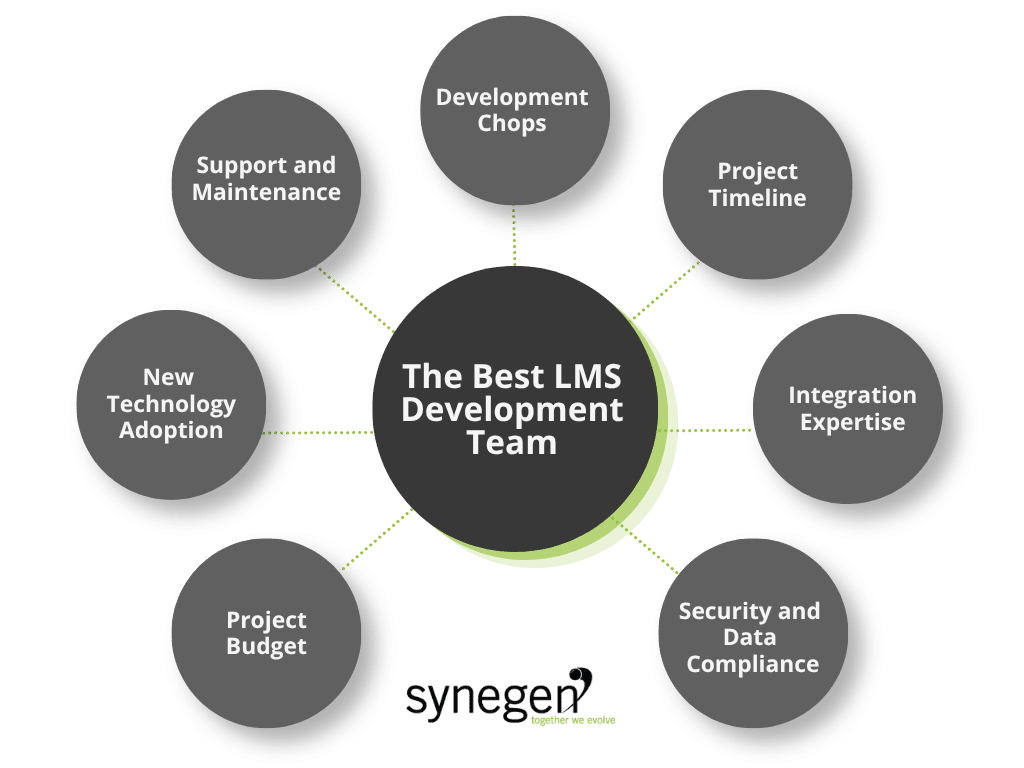
web showing qualities a custom development team should have when working on lms implementation

Additionally, embracing and studying new technologies ensures your products won’t become laggy and outdated. Just like your team and business goals, solutions are in constant evolution.

If you bring a development team an outline of your goals, they should be able to apply the technology and solutions to bring them into reality.

Still not sure how to choose? Read 7 Essential Questions to Ask Before Choosing an LMS Development Company.

2. Determine the Project Scope

Outlining the project- its intended results, the necessary technology, budget, and timing ensures expectations and alignment are set. Each side should know what’s coming next, and when. It’s like having a GPS for your LMS implementation journey.

At Synegen, for example, following an extensive JAD (Joint Application Design) session, we approach projects in two- to three-week sprints, consisting of planning, development, and client demo phases.

This way, clients stay in the loop while receiving exactly what they want. Additionally, every two to four sprints, we host executive review meetings to gather feedback and promote active communication.

Finally, when the project is near completion, we shift into client training and end-to-end testing. This plan keeps the project on track while being adaptable to changing needs and unexpected hiccups. After all, flexibility is everything.

What throws a project off track? Bad communication. Before you start, identify your go-to people, whether they’re the tech gurus, HR heroes, or leaders steering the ship. Let everyone in on who these MVPs are. If you’re working with an external partner, you should clearly know who those main contacts are on their side.

Now, think about how your team communicates. Are you using a dedicated collaboration channel, juggling project management software, hopping on regular meetings, or a combination? Remember, it’s better to communicate too much than too little.

Don’t forget the golden rule: document, document, document! Every move should be recorded in a shared location so the whole group stays in sync.

3. Infrastructure Setup

Infrastructure is where your development partner will shine. After all, it’s why you brought them on! They will help ensure your platform’s front and backends function together properly and can scale seamlessly.

Start by carefully evaluating your infrastructure requirements. Pinpoint the anticipated number of clients and end-users, estimate the storage needs for your LMS content, etc.

Next up, decide where your LMS will call home, whether that’s on-premise or in the cloud. For custom builds, we highly recommend cloud hosting by AWS. It’s not only more scalable but often proves to be a cost-effective choice.

Engage your DevOps team early for this step. Pay special attention to security, scalability, and monitoring. Create policies and expectations ahead of time so that the proper environments can be provisioned.

These measures ensure that your system can adapt swiftly to changes in traffic and demand, maintain optimal performance, and keep costs in check. With the right policies in place, you can ensure that your LMS remains agile and responsive to the evolving needs of your users.

4. Envisioned User Experience

The user experience your development partner creates will make a tremendous business impact.

As you map out your project and implementation, be sure to clearly outline your user requirements and envisioned experience. This will help ensure the features and functionality that are being developed for your LMS are in line with your requirements and ultimately the envisioned user experience.

For instance, what user-level permissions, data protection, and membership tiers do you anticipate? Your developer can take these and ensure the new technology properly handles your needs and preferences.

If you’d like to better understand how your custom LMS developer has handled similar situations previously, ask for case studies or client references. If they don’t have the experience, weigh their suggested changes with your expectations – does their methodology align with your preferences?

Each vertical has pitfalls you and your partner need to be aware of. Document these and have contingency plans for them before starting the build-out. Make sure both parties are working jointly toward the same goal and are comfortable with the risks.

5. eLearning Content

The quality, organization, and delivery of your eLearning content to learners is essential. How does your team and custom developer work with eLearning content?

Are they capable of migrating and adapting SCORM or xAPI packages, building cross-platform integrations for wider access, and building custom pathways?

As you plan your LMS implementation strategy, here’s how a custom developer can help you build the best learning experience for your learners.

Map out Personalized Learning Paths

A developer can help you implement curriculum governance and build highly specific learning pathways for different learner or role types. 
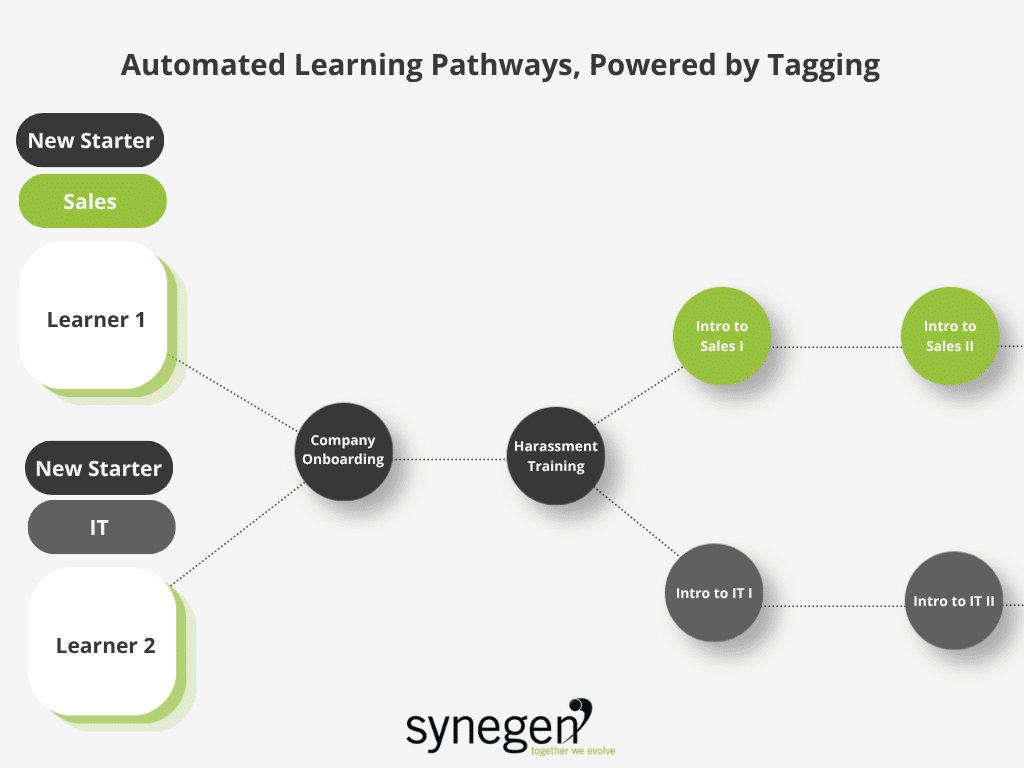
graphic showing automated learning pathways, powered by ai tagging

Through tagging, or AI-technology, your learners can automatically be pointed to the most relevant learning content. 

Take Learning to the Next Level 

Gamification isn’t a passing trend; it’s steadily growing in popularity. In fact, it may soon no longer be classified as a “nice to have”, but as a “necessity”. According to Visu Network, more than 70% of Global 2000 companies now use a form of gamification in their operations. 

These features make it easier to appeal to different learners while creating a more immersive, engaging learning experience. 

AI Technology

LMS providers, like Totara Learn, are revolutionizing content creation, delivery, and management through AI. These tools range from writing assistants, which aid in quicker course building, to SMART goal assistants, which help learners stay on track and complete goals. 

As mentioned earlier, AI course tagging improves user experience by streamlining catalogue search and learning discovery. 

Together, these features completely streamline content creation workflows, so you can give more thought to high-quality production.

6. Data Migration

Properly set and managed LMS integrations drive considerable business value. After all, the data they move helps uncover user behaviors, errors, and new initiatives, ultimately driving critical business decisions. 

But data intelligence can be a challenge without the right support. It can help ensure smooth, secure information transfer. 

Here are some conversation starters to help your team plan your data migration strategy. 

  • Users: Which learning data and metrics are most important to track? How can you prove platform utilization and learning effectiveness?
  • Cross-platform: Which information needs to move to and from our other platforms? When do we need each data point?
  • Compliance and Regulatory: Do any compliance rules mandate how long you need to hold onto data? What about data protection and security protocols?

Custom solutions that effectively manage xAPI and SCORM can give your platform the flexibility to manage diverse learning content and resource transfer.

Additionally, a custom developer can set checks to verify that the data being transferred is accurate, reliable, and complete, ensuring your LMS implementation goes smoothly.

7. Cross-Platform Integrations

Your technology ecosystem streamlines information movement and reduces manual tasks, making it easier to gather, interpret, and act on data. Knowing which platforms you want to connect to your learning system is essential. 

Custom development can help standardize which data will move where, its timing, and who it will be visible to. This is achievable through various integration types like middleware, ETL, API, and more.
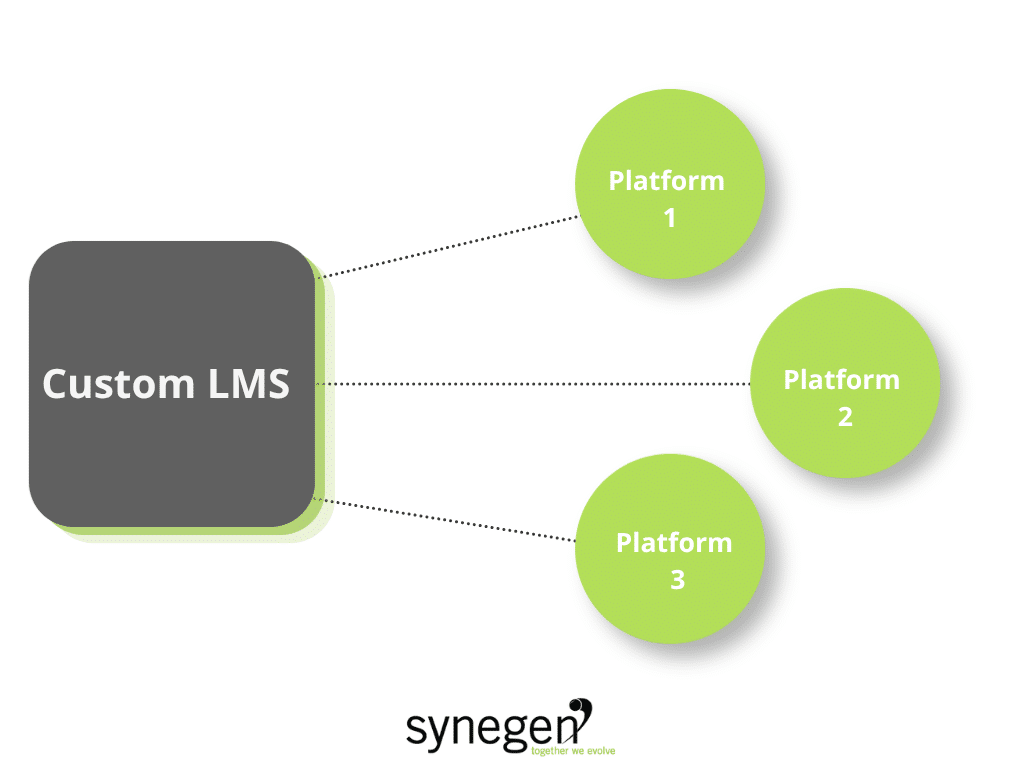
concept graphic of a custom LMS with multiple system integrations 

For example, a vital integration for many businesses is the seamless integration of e-commerce platforms within the LMS, such as Shopify. These integrations help provide flexible payment methods, improve the user experience, and drive more efficient sales management processes.

Or, an HRIS and CRM connection makes it easier to understand the impact of training, make faster promotions, and see where future organizational efforts should be focused.

A hub-and-spoke integration architecture centralizes your learning program, ensuring your LMS is enriched by wider contextual information. Your decision-makers benefit from easier access to fuller information, and your wider organization benefits from clean processes and clear direction.

8. Feedback Loops

As you build out your LMS implementation strategy, keeping the right stakeholders in the loop at the right time is imperative.

Try taking a top-down approach: who is the ultimate decision-maker? Whose opinions will have the most weight, and when will their thoughts be most impactful?

For the wider company picture, your executives should have an understanding of what’s coming. Technical: your IT department. Platform utilization: department heads and managers should be trained on daily LMS use. 

Beyond the implementation, whether they’re the Head of Learning and Development or a new hire working through onboarding, it’s important to provide easy ways for your team to provide feedback on the services and training content. Insights from across your organization will make platform improvements and refinement easier to undertake.

9. Testing and QA

You’re approaching the end of your LMS implementation – now’s the time to get excited! But before the new system can go live, thorough testing, quality assurance, and final run-throughs are non-negotiable. 

This phase allows you and your custom developers to meticulously comb through the system, pinpointing and resolving any issues before it reaches the hands of clients or end-users. Failure to catch and action bugs before production can damage your custom developer’s reputation and your platform’s reputation with learners. Test, test, test. 

Reflect on Step 4: Does the experience match the envisioned journey for your users on the platform? By now, you should have a clear picture of exactly how your end-users will move through the training platform. 

From the first hello to ongoing platform support, and everything in between, it should all align with expectations. Any deviation from your LMS implementation plan should be addressed promptly.

10. Onboarding and Training

Finally, it’s time to prepare your end users for success! Your custom developers can help you shape your onboarding process. 

From account setup and management, hands-on training sessions or curated “how-to” playlists can help learners master the ins and outs of the LMS in no time. 

Taking time to properly map out LMS onboarding improves their user experience, positively impacting engagement in the long run. After all, learners are more than just users moving through training modules. They can be champions for your business, learning resources, and service. 

A proactive and involved approach always helps with wider platform adoption and use. 

LMS Implementation with Synegen

Implementing a custom LMS is a lengthy and high-stakes process – one that should never be taken lightly. 

At Synegen, we understand the importance of aligning technology and learning management solutions with your unique learner and business requirements. That’s why we offer ongoing consultation and partnership to continuously improve solutions for organizations. 

Book a call with our team of experts to discuss the specific needs of your organization and help you find your best-fit eLearning technology!

Beyond the Code Newsletter

Where technology moves beyond the build—to real business impact.

Every month, we break down how integrations, automation, and real-time data flow can solve messy business problems and drive actual growth.

Related Content
group meeting to discuss choosing an LMS provider
7 Essential Questions to Ask Before Choosing An LMS Development Company
7 Essential Questions to Ask Before Choosing An LMS Development Company The LMS development company you...
worker using mobile e-learning application
What Makes an LMS Mobile App Truly Effective? 10 Must-Haves for Learning That Works Anywhere
What Makes an LMS Mobile App Truly Effective? 10 Must-Haves for Learning That Works Anywhere We cover...
group meeting, with custom lms integration screens
LMS Integrations: How Smarter Connections Actually Drive Value
LMS Integrations: How Smarter Connections Actually Drive ValueLMS integrations are more than just simple...