
Organizations are under pressure to reskill, upskill, and train their employees faster. New technologies, changing customer expectations, and ever-evolving job responsibilities can make yesterday’s expertise less relevant almost overnight.
The instinctive response? Add more training.
But training without a roadmap leads to negative outcomes. The north star to guide learning is to determine: what does each learner actually need to learn?
It becomes increasingly difficult to answer at scale. A manager may understand the strengths and weaknesses of a small team, but across an organization, competency data is often fragmented between annual reviews, goals, learning systems, peer feedback, manager notes, spreadsheets, and compensation processes. When those systems are siloed, decision-making falters, often relying on job titles and broad assumptions, rather than demonstrated data and need.
The opportunity is to turn performance management into the engine that drives employee reskilling.
You Can’t Reskill What You Can’t Measure
Most organizations already collect a great deal of information about employee performance. The problem is that information is rarely structured in a way that creates a clear picture of skills and competency.
For instance, an annual review may tell you that an employee “meets expectations”. A learning system may tell you that the employee completed six courses. A manager may have notes from coaching sessions. A peer may have observed a capability that never appears in either system.
A skills-based approach begins by defining what good performance actually looks like. Instead of relying on a single overall score, organizations can establish proficiency levels for the skills and competencies that matter to a role.
For example, one organization can define four proficiency levels:
- Developing
- Professional
- Advanced
- Lead
Those levels become much more meaningful when they are tied to observable criteria. An employee can be Advanced in one competency, Professional in another, and Developing in a third. That gives managers a much more actionable picture than a single performance score ever could.
Course Completion is Not Competency
One of the most important distinctions in a modern workforce development strategy is the difference between learning activity and demonstrated capability.
Completing a course tells us that someone participated in learning. It does not automatically tell us that the person can perform the underlying skill on the job.
The same is true in reverse. A strong employee may demonstrate advanced capability through experience even if that person has never completed a formal course on the subject.
This is why performance and learning data need to work together. Employee reskilling and upskilling relies on accurate and comprehensive data.
This goes beyond tracking what courses staff have completed. It’s a collection of evidence that employees can perform certain skills, and the development that’s necessary to drive that capability forward.
Measure Competency Where The Evidence is Created
A powerful way to make competency measurable is to connect skills and competencies at the level where performance evidence is actually captured.
Instead of tagging an entire performance review with a broad competency, individual evaluation questions or criteria can be associated with specific topics, skills, and competencies.
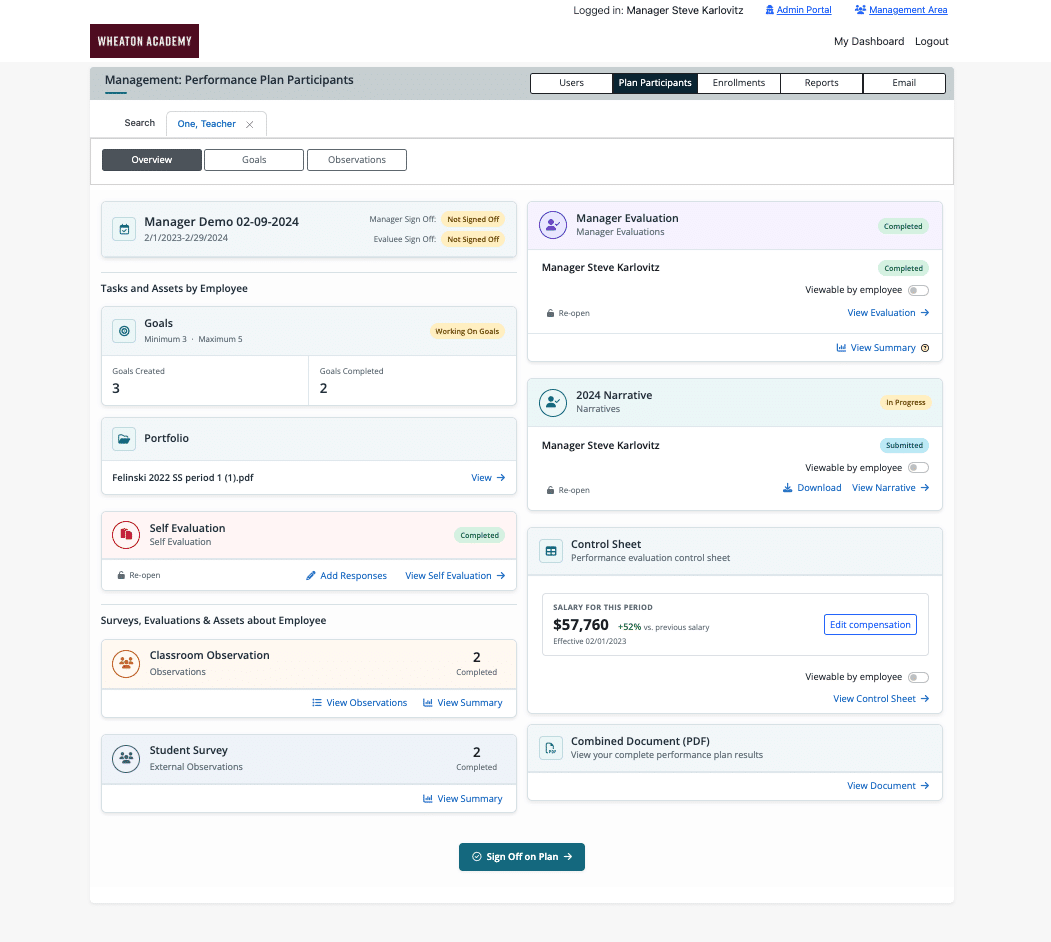
Consider a teacher evaluation. One might evaluate lesson planning; another might assess classroom management. A third might measure how effectively the teacher adapts instruction based on student understanding.
Behind each of those questions, the system can associate the relevant topic, skill, and competency.
That means the organization is not simply collecting a review score. It is accumulating structured evidence about capability.
The evidence can come from multiple sources, including self-evaluations, peer evaluations, manager reviews, goals, narrative feedback, observations, and learning activities. Together, those inputs create a richer view of employee proficiency.
From Performance Gap to Development Plan
Once a competency gap is visible, learning becomes much more targeted.
Instead of assigning the same course to everyone in a role, organizations can connect learning content to the skills and competencies it is designed to develop. When the performance process identifies a gap, the appropriate learning can then be recommended or automatically assigned based on the organization’s rules. This improves long-term engagement and retention.
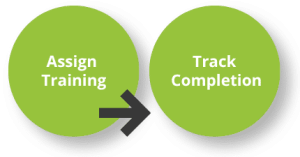
Traditional training administration often looks like this:
A connected performance and learning strategy looks more like this:
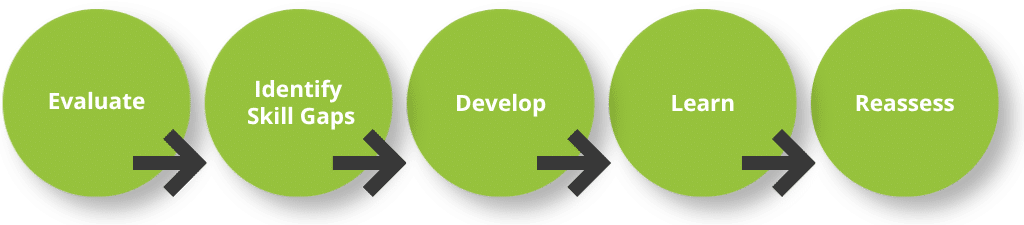
This creates a continuous development cycle. Learning is no longer a separate activity that happens after the performance review. It becomes the response to the evidence generated by the performance process.
A Real-World Example: Living Curriculum and Employee Reskilling with Wheaton Academy
Wheaton Academy’s Living Teacher Development Model provides a practical example of how this approach can work.
The Living Curriculum model was created around a business need that many organizations will recognize: how do you define excellent performance, help people develop toward it, and reward growth in a way that is more meaningful than simply relying on tenure or credentials?
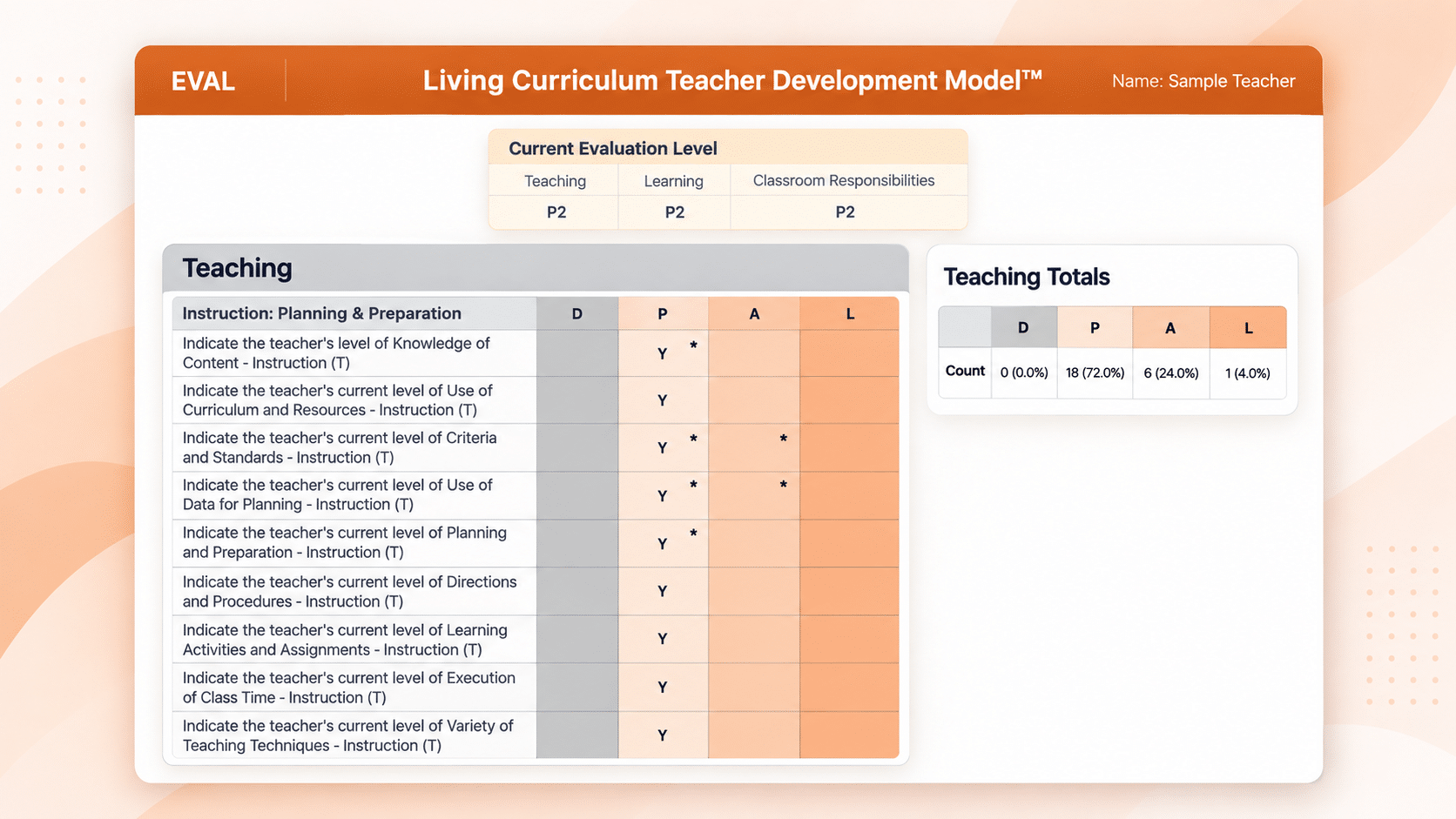
For teachers, the model evaluates performance across multiple dimensions and proficiency levels. The process can include goals, self-evaluation, peer input, manager review, narratives, and learning. Rather than treating each of those activities as a separate process, they contribute to a broader view of skills and competencies.
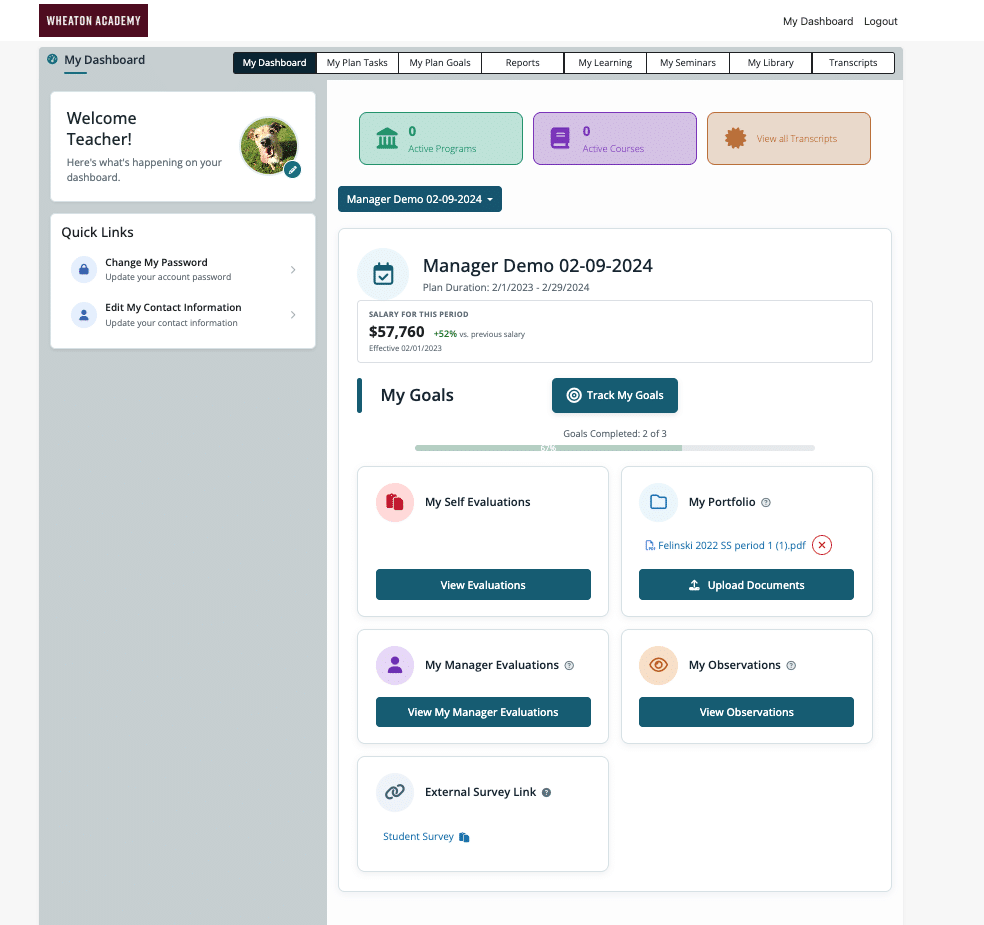
The technology supporting the model allows performance plans to be assigned to different audiences and configured around the metrics that matter for each role. Individual evaluation criteria can be associated with topics, skills, and competencies, which creates a more granular picture of where an employee is performing well and where development is needed.
When a gap is identified, relevant learning can be recommended or assigned automatically. The next performance cycle then provides new evidence that can help determine whether the development effort produced the desired result.
The goal is not simply to digitize an annual review. It is to create a system in which evaluation and development continuously inform one another.
Connecting Development to Compensation
Living Curriculum also demonstrates why this data matters beyond learning.
Wheaton Academy’s approach connects performance and competency development to a pay-for-performance model. Historically, the compensation process relied on a sophisticated spreadsheet that incorporated multiple factors and weighted performance dimensions.
That process is now being translated into a configurable compensation module that can apply the organization’s methodology more consistently and at scale.
The important point is not that a performance score automatically determines someone’s salary. The value is that the organization can use a more complete body of evidence when making compensation and advancement decisions.
When employees can see what proficiency looks like, understand where they currently stand, receive development tied to specific gaps, and see how growth can influence career and compensation outcomes, performance management becomes much more than an administrative requirement.
It becomes part of the employee value proposition.
Where AI Can Help
A skills-based model can produce a tremendous amount of information. Hundreds of evaluation questions, courses, activities, competencies, and skill relationships quickly become difficult to manage manually.
This is where AI can provide meaningful value without replacing human judgement.
One practical use is skills tagging. AI can analyze evaluation criteria and learning content and suggest the topics, skills, and competencies that best describe them. An administrator can review and approve those recommendations rather than manually classifying every question and course from scratch.
AI can also improve learning recommendations. If the system understands both the employee’s competency gap and the skills associated with available learning, it can help recommend the content most relevant to that individual’s development needs.
AI’s role should be to reduce complexity and surface meaningful problems, not to make consequential employment decisions on its own. Managers and organizational leaders should remain responsible for evaluation, coaching, promotion, and compensation decisions.
A Better Way to Think About Employee Reskilling
The organizations that become most effective at employee reskilling may not be the ones with the largest course catalogs. They may be the ones that are best at connecting performance evidence to the right development at the right time.
When those pieces work together, the process becomes a continuous loop.
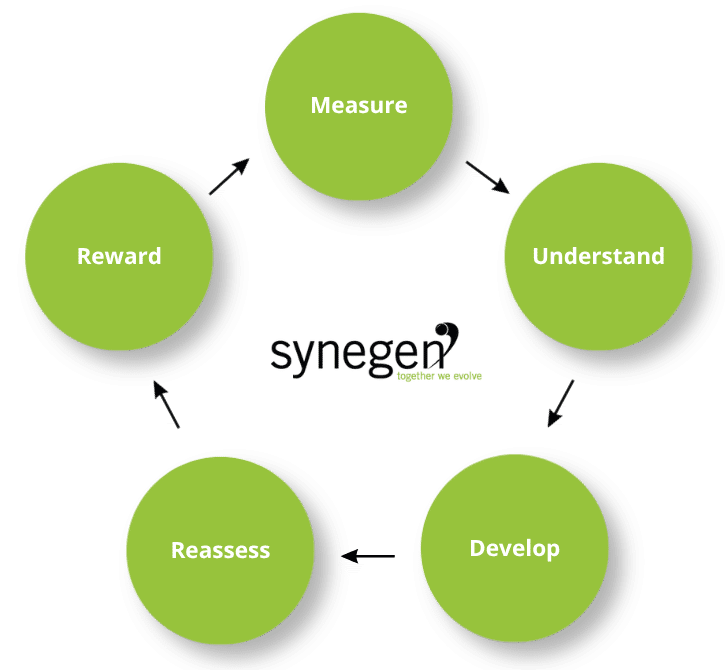
This is the real opportunity behind streamlined reskilling.
The goal is not simply to build a better performance review or a smarter learning platform. It is to connect performance, skills, learning, and career progression so that each makes the others more useful.
For organizations trying to develop people faster without compromising quality, that connection may be the difference between delivering more training and actually building more capability.
Ready to maximize your employee reskilling programs? Book a call with our team to get started!