LMS Integrations: How Smarter Connections Actually Drive Value
LMS integrations are more than just simple plug-ins. The strongest connections cultivate a learning ecosystem that impacts all levels of enterprise business operations. Discover how custom integrations maximize value.

June 23, 2026
A scalable learning infrastructure hinges on the cross-platform integrations between your Learning management system (LMS) and other systems. These connections can do more than simply exchange data; they can future-proof your business.
They transform LMS platforms from training delivery tools into dynamic, data-driven hubs that support personalized learning, smooth operations, and well-rounded business alignment.
But here’s the reality: most organizations still treat integration as a checklist item, not a competitive advantage.
Keep reading, and we’ll cover:
- How LMS integrations impact adaptability and growth
- Benefits of custom-built LMS integrations
- A comparison of LMS Integration methods and use cases
Redesigning LMS Integration for Flexibility and Scale
When many L&D professionals hear the term “LMS integration,” they might think of plug-ins or apps that connect at the click of a button. While true, this view oversimplifies what’s truly involved.
LMS integrations can do more than just connect apps and sync data.
A custom enterprise software developer, like Synegen, can help your team plan across multiple dimensions: from the underlying tech infrastructure and interoperability to data management, user experience, and operational workflows.
Overlooking these elements, especially when your business is growing, comes with costly data integration challenges, impacting opportunities to enhance both learning outcomes and business impact.
LMS integrations streamline internal processes and better organize data, directly supporting business growth. Your team can access valuable information, such as HR and licensing records. Your LMS doesn’t have to be at the center of your operations, but it does need to have access to the platforms that make your operations possible.
This ensures long-term scalability and compliance.
How to Inject Purpose Into Your LMS Integrations
Most LMS integrations are shallow. They connect tools, but they don’t align with strategy.
Introducing custom LMS integrations is a process of designing connections that reflect how your organization truly operates, not just defaulting to the plug-and-play options SaaS platforms offer.
Think in Terms of Synchronization
One-way information flows between platforms are a good start, but they still require manual data maintenance. Without a two-way flow of data between the systems, information can easily become stale. You’ll frequently find yourself exporting or manually entering new data into the rest of the systems.
For example, integrating your LMS with third-party learning providers such as LinkedIn Learning, Go1, or Coursera ensures that content is seamlessly delivered and tracked, regardless of where it originates. This reduces manual course and resource updates.
Prioritize Workflow Flexibility Over Setup Speed
Plug-and-play tools are built for ease of use and speed, but this convenience usually comes at the expense of flexibility. While quick to set up, you ultimately lose the freedom to customize workflows with specific triggers, conditions, context, or add role-based logic that most real-world scenarios demand.
Custom-built LMS integrations inject deeper layers of logic into user experience and learning strategies. This includes adaptive role-based onboarding, geography-tied compliance paths, and customizable dashboards and menus.
For instance, an SSO (Single Sign-On) Integration connects your LMS to identity providers like Okta, Azure AD, or Google Workspace, allowing users to log in with existing credentials. This improves security through centralized authentication, reduces password fatigue, and significantly boosts user adoption.
If your integration can’t flex with your organization, it can’t grow with it either.
Design Data Flows for Decision-making
The surface-level goal of LMS integrations is to deliver and align data. The ultimate goal is to improve business outcomes.
Data that’s structured only for visibility just adds noise. It becomes actionable when it’s tied to business rules, triggers, and KPIs. Yes, cross-platform data should reflect activity – but the best integrations also help shape it.
*Tech Tip: Keep clear integration documentation.
Documentation is like an instruction manual for tech teams. It explains how systems interact, what endpoints exist, what data formats are used, and how authentication works.
Missing details force developers to reverse engineer connections, leading to longer development times, fragile integrations, and higher risk during updates.
The Value of Better LMS Integration
Founded in 2001, Synegen boasts over 25 years of experience in custom enterprise software development. Across hundreds of successful projects, we’ve injected real business strategy into each custom integration we’ve built, prioritizing workflows, reporting needs, and performance goals. Our data integration services don’t just streamline information sharing; they create real value across the board.
Here’s how.
Saving Hours of Time and Resources
LMS integrations configured by Synegen quietly reduce operational loads by automating tasks that are notoriously known to eat up hours of an L&D team’s time.
Oakland Schools, a Synegen client, noticed they were losing time sharing valuable resources and workspaces for new users. Synegen introduced a web services integration to Google, which automatically shares files, calendars, hangouts, and YouTube content with the right learners. With reduced manual effort, Oakland Schools’ learning platform is now structured around collaboration and a strong sense of community.
Here are more ways teams like yours can get time back:
- Automate course assignments, enrollments, and reminders based on real-time updates from systems like your HRIS or CRM.
- Keep learner profiles accurate and current by syncing data directly with HR systems, eliminating manual updates.
- Track learner completions, certifications, and progress across your LMS, HRIS, and third-party platforms (like LinkedIn Learning or partner portals) without manually exporting, merging, or cleaning spreadsheets.
- Give teams more time to focus on improving program design and delivery.
- Improve overall efficiency without having to scale headcount or resources.
Ensuring Reliable, Actionable Insights
LMS integration ensures real-time synchronization of learner data across multiple platforms, eliminates redundancies, minimizes errors, and gives L&D and HR a single, reliable source of truth. With cleaner, centralized data, it becomes easier to allocate resources, develop talent, and measure training effectiveness.
Mozarc Medical, for example, struggled with repetitive onboarding and employee recordkeeping. Synegen introduced a powerful system integration with Dayforce, which automatically creates accounts for new hires, pauses training for employees on leave, and updates user information based on status, like promotions or deactivations.
Now Mozarc’s L&D team connects learners to necessary courses sooner, and with less hassle.
Here’s what that looks like in practice:
- Centralized, real-time data synchronization across learning, HR, and business systems
- Elimination of redundant records and data silos
- Improved data accuracy for compliance, performance tracking, and reporting
- A consistent source of truth for leadership and L&D decision-making
- Enhanced analytics capabilities that support strategic workforce planning
Creating Better User Experiences and Improving Engagement
LMS integrations remove friction from the learner experience, allowing them to focus on their growth rather than technical barriers. For leadership, this means higher engagement, increased course completion rates, and more positive learner feedback.
NCCER, a long-time Synegen client, was using legacy systems that could no longer flex with the business or integrate with other systems. This created data silos and delayed responsiveness. They teamed up with Synegen to create a cloud-hosted platform to deliver training, educational materials, and certification programs to tradespeople worldwide.
In addition to building a proprietary mobile learning application, CraftPro, Synegen developed a variety of real-time integrations to Salesforce, the NCCER registry, and a third-party testing platform. Additionally, we helped them introduce an e-commerce integration to Shopify, creating a seamless course purchasing experience. To date, they’ve issued over 32 million industry-recognized credentials to 24 million craft professionals!
By removing obstacles and creating a frictionless experience, LMS integrations directly impact learner satisfaction and outcomes. This, in turn, enhances organizational performance.
Your team can thrive with:
- Access to learning tools across platforms
- Personalized learning paths enabled by integrated user data
- Fewer technical barriers, increasing adoption and satisfaction
- Higher learner engagement and completion rates due to reduced friction
- Positive learning experiences that boost overall employee satisfaction and retention
Connecting Learning to Strategic Goals
LMS integrations help teams connect training back to broader business objectives. By integrating your LMS with tools like HRIS, CRM, and performance management systems, leadership can tie employee development directly to organizational goals.
The American Council of Exercise (ACE) wanted to improve internal operations with a flexible LMS and engage fitness professionals with accessible lessons, increase recertifications, and boost profits with e-commerce capabilities.
Synegen built an LMS platform that gives ACE’s in-house designers the freedom to develop creative designs and courses. Plus, we integrated the platform with GoToMeeting webinars and an e-commerce platform, helping ACE recertify more trainers sooner.
When training is strategically linked to revenue growth, customer satisfaction, or operational efficiency, integrations can help drive business performance and ensure that learning investments support the company’s long-term vision.
Here’s what you should be on the lookout for:
- Integration with performance systems, linking learning outcomes to KPIs
- Ability to map training impact to broader objectives like revenue, customer satisfaction, or compliance
- Data flow between HRIS, CRM, and LMS, enabling strategic talent development
- Alignment between employee growth and business performance
- Better visibility for leadership into how learning supports business priorities
Adapting to Growth and Change
As organizations grow, so do their learning needs. LMS integrations ensure that the learning environment is scalable, making it easier to add new users, expand course offerings, and adapt to changing business or market priorities.
Athens Technical College (IOTIS) struggled to onboard and support new learners across different state-run organizations and initiatives. Synegen customized Totara Learn LMS, helping them diversify course offerings, organize learners by audience, and generate on-demand reports.
Synegen also introduced a system integration with PeopleSoft, which helps IOTIS automate user provisioning and enrollment. Now their team is nimble, serving dynamic training needs for over 10,000 learners.
These are must-have LMS integration capabilities:
- Scalable architecture that supports growing user bases and new learning programs
- Modular, API-friendly design that allows flexible integrations over time
- Ease of onboarding for new employees, tools, or partners
- Support for evolving business models (e.g., remote, hybrid, global teams)
- Future-proofed systems that adapt to regulatory, technological, or strategic shifts
Choosing the Right LMS Integration: Tools and Methods
The integration method you choose is just as important as the tools you connect. These systems control how your platforms communicate and when, how information is shared and processed, and protocols for timing and security.
Let’s review four of the most common LMS integration methods and popular use cases.
Application Programming Interface (API)
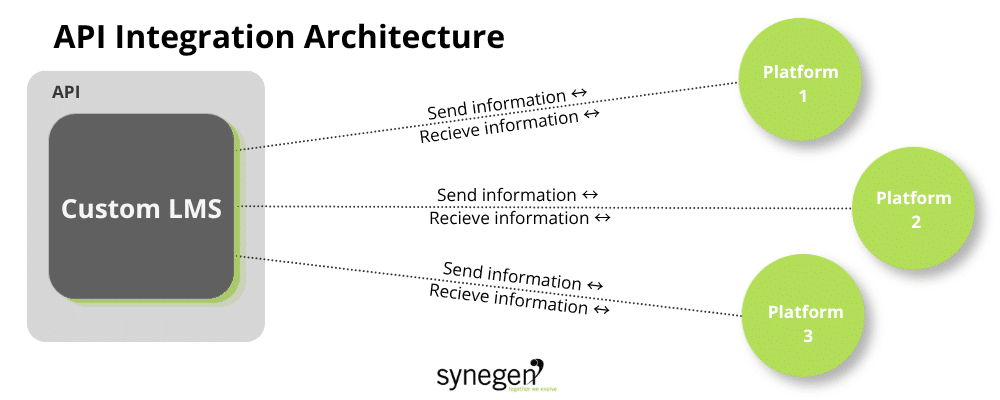
APIs are the most common, flexible, and powerful integration method. Their rulesets and protocols enable secure and scalable integrations with a variety of platforms.
They act as a bridge between software, enabling one program to request data from another. Additionally, they keep internal information hidden and protected.
Use Case: CRM Integration
APIs can be used for any LMS integration. Connections to CRM platforms, such as Salesforce or Hubspot, are the most common, supporting customer training, partner onboarding, and account-based learning strategies. A custom-built API can ensure learning progress is directly tied to deal stages, renewal cycles, or account segmentation.
Synegen is a certified Salesforce Consulting Partner and has a partnership with HubSpot; we help our clients implement, customize, and connect these systems with their LMS.
Webhooks
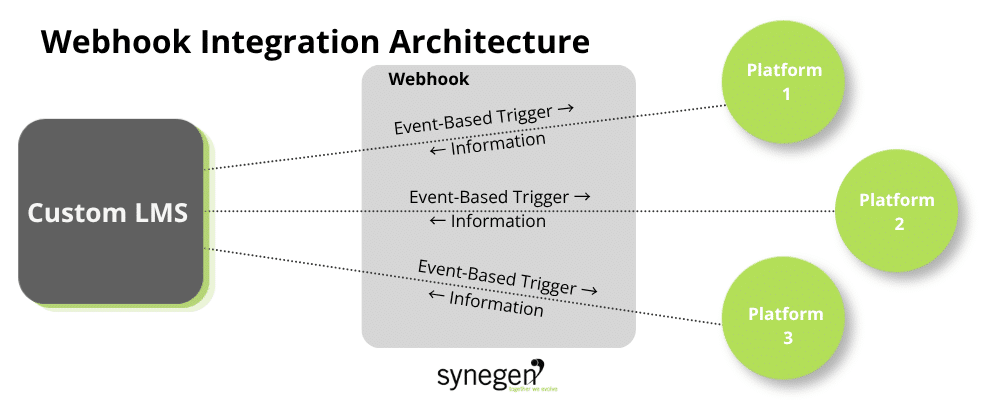
Webhooks, also known as callbacks, are used for real-time data syncs. Unlike a traditional API, which requires your LMS to repeatedly prompt your server for updates, Webhooks operate on event-driven actions (e.g., trigger on course completion).
Webhooks can be used with APIs, giving you the fullest control over your data and the actions that trigger its transfer.
Use Case: e-Commerce & Payment Gateway Integrations
Middleware Platforms
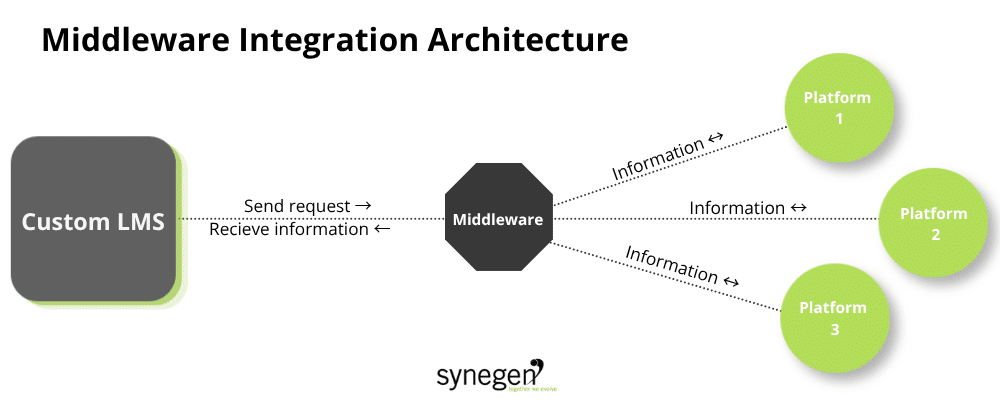
Middleware bridges gaps between applications. Not to be mistaken with APIs, Middleware sits in the center of a system architecture, operating outside of your custom LMS. These applications manage and streamline complex workflows, reviewing information before it reaches your LMS.
Middleware does more than just transfer data. It actively intercepts and transforms it based on tokens, formats, and routes. This adds an additional layer of security and efficiency to your cross-platform integrations.
Use Case: HRIS (Human Resources) Integration
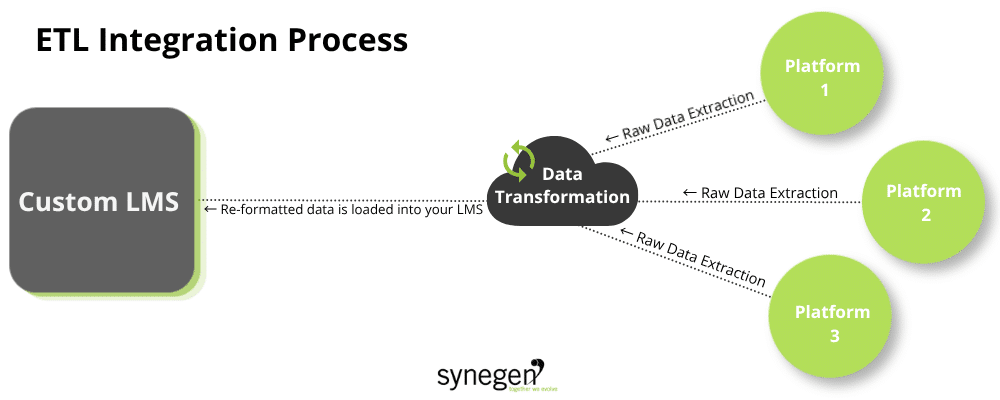
ETL (Extract, Transform, Load) Integration
ETL integration is the process of moving raw data from various platforms, processing it, and loading it into its final destination: your custom LMS, for example.
This system is useful for managing data lakes, business intelligence, and high-volume analytics. With one source of truth, ETL helps businesses gather, understand, and action their analytics sooner.
Use Case: Analytics & Reporting Tools Integration
An ETL integration can seamlessly connect your LMS to a variety of reporting tools, such as Power BI, Tableau, or Google Data Studio, to surface insights on training impact, learner performance, and organizational trends.
With data transformation, teams ensure consistency across all platforms.
Expedite Growth with Synegen-Built LMS Integrations
Custom-built LMS integrations do more than transfer information across platforms. They enable smarter, faster, more personalized learning at scale.
Whether you’re optimizing onboarding, rolling out global compliance, or driving partner enablement, how you integrate will ultimately determine how well your LMS performs.
With over 25 years of custom software development and business consulting experience, Synegen is the go-to partner of enterprise businesses across the United States. We help our partners organize their learning and development programs, so they can maximize business outcomes.
It’s time to move beyond connectors and think like a systems architect: book a call with our experts to design integrations that grow with you!
LMS Integration FAQs
What is LMS Integration?
LMS integration is the process of connecting your learning management system to other platforms across your organization. Such as HR systems, CRMs, content providers, analytics tools, and more. Done well, it transforms your LMS into a data-driven hub that supports personalized learning, streamlined operations, and measurable business outcomes.
What are some best practices for LMS integration?
Best practices for managing LMS integrations include:
- Build for two-way data flow
- Match your method to your use case
- Choose flexibility over speed
- Design data flows for decisions
- Document everything
This way, you can build a technology ecosystem that holistically drives business performance and outcomes.
Get Insights Sent Straight to Your Inbox
Related Content