Custom Software vs. Off-The-Shelf? How to Choose What's Right for Your Enterprise Business
Custom software vs. off-the-shelf? What’s right for your business? In this article, we weigh the pros and cons of commercial, modular, and custom-developed software, and how your business goals point towards the best path to take.

April 2, 2026
Off-the-shelf or custom software? When it comes to software for enterprise businesses, the choice isn’t just technical. It’s strategic.
Yet too often, organizations make their decisions based on what’s faster or cheaper without considering how the choice aligns with their business model, growth goals, or operational complexity.
Keep reading, and we’ll break down when each approach is the right fit, so you can make informed decisions based on your goals, the complexity of your needs, and long-term value, not just the price tag.
What is Off-The-Shelf Software?
Off-the-shelf software, also referred to as SaaS (software as a service), out-of-the-box, or commercial off-the-shelf (COTS), is software that comes as a pre-set package. Examples of out-of-the-box products include Microsoft Office, QuickBooks, and Asana. These platforms are developed for the mass market, offering solutions for common problems.
Generally, off-the-shelf software is available to download and use immediately. Or, they require a short onboarding and training period – perfect for teams who need to implement a solution as soon as possible.
Compared to bespoke software, they are far less configurable, since they’re designed for wide audiences. Additionally, commercial software is usually available through subscription packages. While affordable for small businesses, subscription prices can be crippling as teams scale. Who wants to pay for individual licenses when your team grows into the triple, quadruple, or quintuple digits?
When Off-The-Shelf Software Makes Sense
When you’re buying time, not transformation
Commercial software is great when the goal isn’t to innovate, but to stabilize, standardize, or survive. For businesses with shifting priorities, lean teams, or those that anticipate organizational change, the real value might be in not building anything at all.
Custom software has its place, but not every moment is the right moment to build.
Off-the-shelf solutions provide the speed, structure, and breathing room to quickly stabilize operations and assess where customization will truly drive competitive advantage down the road. It’s not an either/or decision. It’s about prioritization.
When your bottleneck isn’t tech, it’s process
Off-the-shelf software shines in giving businesses a baseline of operational clarity. They can be a crucial first step in addressing the underlying process inefficiencies that are limiting daily output.
With their built-in workflows, data management capabilities, and standardized interfaces, SaaS products introduce much-needed structure and discipline to processes. This is especially useful for teams transitioning from paper-based systems to digital or outdated programs to modern software.
With a better understanding of core problems and reduced gaps in data and tracking, you can get your business back on track. Then you can determine if a future investment in custom-built software is necessary.
When software isn’t a destination, it’s a bridge
Sometimes you’re not building a forever solution; you just want a path to the next phase. Software packages can serve as strategic stepping stones that help you quickly standardize processes, untangle business complexities, and keep day-to-day functions running smoothly.
They buy you critical time to rethink your strategy and outline the tech stack you’ll ultimately need.
That said, it’s important to go in with eyes wide open. While these tools offer speed and structure, some come with constraints, like limited flexibility or vendor lock-in contracts, that can make switching later more difficult.
The key is using them intentionally and with a clear exit plan in mind: fill functional gaps now, but always keep your long-term roadmap in view so you’re not boxed in when it’s time to scale or specialize.
When you’re solving a well-defined problem, not inventing a new one
Off-the-shelf software is designed to effectively tackle widely shared common business obstacles. If you need internal team communication, you turn to Microsoft Teams or Slack. Accounting and invoicing: Xero, Sage, or QuickBooks. HR management and hiring: ADP or WorkDay.
These products save time, resources, and effort. Rather than build a solution from scratch, it’s more practical to utilize software that’s already been tested and refined through the experiences of others in your industry.
Choosing a ready-made solution also saves you time to focus on more strategic, unique problems that require true innovation. So, what is custom-built software, and when does it become a necessity?
What is Custom Software?
Custom software, also known as customized, bespoke, or proprietary software, is a digital made-to-order platform built to meet the needs of a single business.
Custom software development involves identifying and diagnosing specific issues, then designing, building, and rolling out a digital system to solve those problems.
Usually, these services are provided by a team of professional developers and business consultants, like Synegen. These providers do the heavy lifting, building and testing the software, and offering highly specific and advanced solutions.
Large projects can take months or even years to complete, but the flexibility and modifications compared to commercial software are unmatched. Because the process can be lengthy, choosing a compatible development team is crucial.
Additionally, depending on the level of complexity, time to launch, and ongoing support, costs can vary significantly. Typically, custom software development requires more capital upfront, but eases over time. Off-the-shelf software is comparatively cheaper to implement, but often costs more than custom software in the long run.
While it takes more time to set up and implement, and requires more upfront, custom-built software can have tremendous business impacts compared to out-of-the-box solutions.
When Custom-Built Software is The Better Fit
When your software is your business model
If how you serve customers, capture revenue, or operate internally is a big part of your competitive advantage, a generic tool can compromise the quality of your services. Off-the-shelf solutions might not be enough to capture the unique nuances of your operations. Plus, their platforms are often limited, hindering your ability to differentiate and scale.
Custom software, on the other hand, offers the freedom to create a solution tailored specifically to your needs. This way, your core systems, strategic goals, and long-term vision stay aligned. Investing in a platform that’s just as unique as your business reinforces your competitive advantage.
When connection is more important than interfaces
Out-of-the-box tools look polished but often come with limitations around how they communicate with other platforms. If your team relies on tight, reliable, and complex integrations across systems, custom-built software gives you the power to build integrations that work exactly the way you need them to.
When you want your software to work cohesively with your existing tech stack, and not just look good on the surface, custom software development is the way to go.
When evaluating developers, their partnerships with platforms like Amazon Web Services, Salesforce, and Totara, plus expertise with open code software and API, make it easier to implement or build integrations to other platforms.
Read more: 5 Costly Data Integration Challenges (and How to Overcome Them)
When your growth plan will break most off-the-shelf models
High-growth companies often outpace the flexibility of commercial off-the-shelf platforms. The benefits of custom-built software for long-term growth are vast, as tailored applications are inherently better-suited for swelling headcounts and business developments. Their structures can more easily accommodate more users, host more data, and integrate with a variety of platforms.
They scale when you do.
When you introduce software that’s aligned with where you’re headed, rather than where you are, you ensure your technology infrastructure properly supports your goals. After all, your software should flex and grow with you, not limit your capabilities.
When your workflows are a competitive weapon, not a quirk
Workflows are the literal engine of businesses. They’re how teams perform daily work, manage their margins, and ensure customer satisfaction. Operations are a key business differentiator that requires custom technology to maximize their efficiency.
Here’s how custom software optimizes complex workflows. The Town of Los Altos Hills recognized that they were struggling to manage its municipal projects. The town wasn’t able to effectively respond to obstacles, couldn’t generate accurate reports, and was failing to keep the public informed. Plus, their internal processes were affected by a lack of standardization, as vital information was stored across multiple SaaS platforms and buckets.
Synegen consolidated the city’s tools into a comprehensive web application. From one dashboard, city workers keep internal processes aligned and on time. Here, they effectively organize, manage, and track town projects, financial statuses, and reports. Plus, we built a public-facing experience that enables townspeople to access overviews and updates on all projects, without having to contact the government.
With up-to-date and organized information, the government can make stronger decisions, schedule projects with confidence, and maintain open communication with its citizens – without additional admin work.
Custom software offers the flexibility to optimize and scale these unique workflows, ensuring they continue to deliver a competitive advantage rather than being constrained by off-the-shelf solutions. By aligning your technology with your distinct business processes, you strengthen the very factors that make your business stand out.
When change management is your MO
No one likes change. Overwhelmingly, businesses and customers notice when operations, communications, and management are clunky and outdated. But the perceived effort of moving to a new solution: how it will affect everyday work, and the risks of it not working out, leaves many companies in limbo.
However, companies that don’t innovate get left behind. Embracing a culture of change management turns the process from an overwhelming leap of faith into a growth opportunity.
Assessing different custom software developers, their processes, and final products is weighing out the very future of your business. That’s why it’s important to choose a software development company that has a reputation for deep expertise, customer care, and a collaborative spirit. These attributes quickly build trust and alignment, so you can create the best software as a team.
When you welcome change, and the final product is ready to roll out, your business will gain a true sense of ownership over the tool and excitement to get started.
Custom Software vs. Off-The-Shelf: Comparing the Price Tag
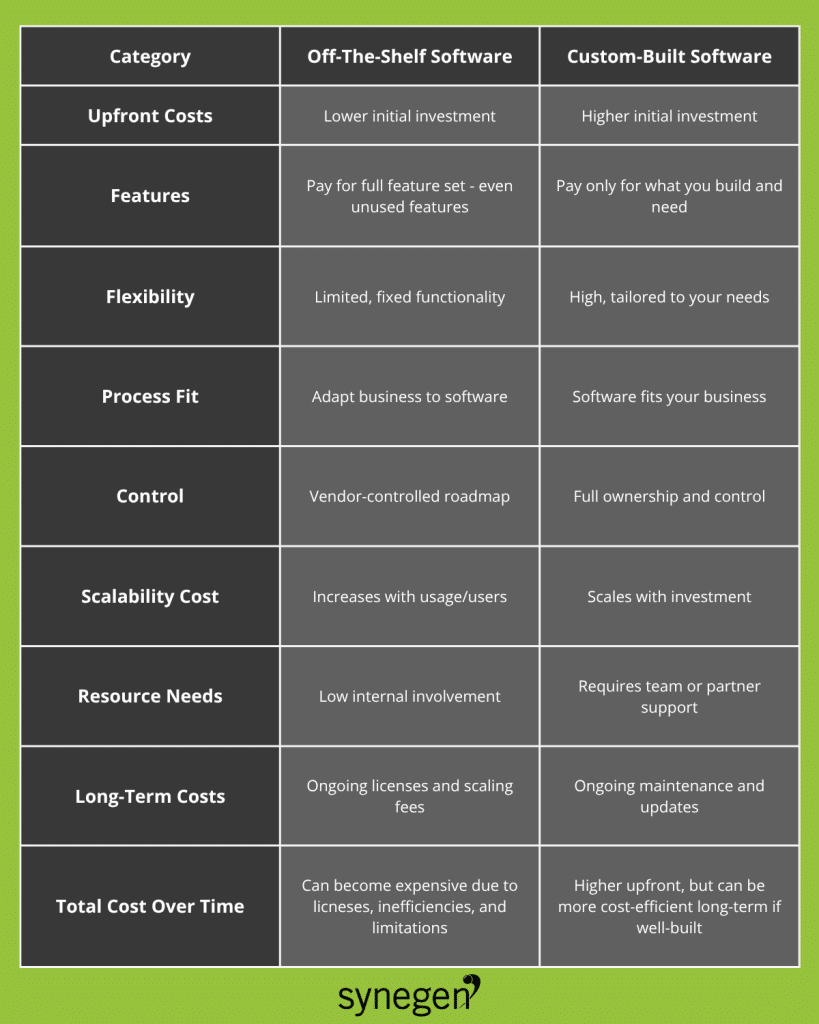
When evaluating custom software vs. off-the-shelf, considering both the upfront costs and hidden long-term expenses is essential.
While more straightforward, the initial costs for off-the-shelf software don’t always reflect the full financial impact. Even more, custom software also introduces ongoing costs that can be surprising to businesses in different ways.
Upfront Costs:
Off-the-Shelf Software: Oftentimes, they have lower initial costs with per-user licenses or subscription fees. But you’ll typically pay for the entire suite of features, even if some of them go unused.
Custom Software: Consistently, they have a higher initial investment for design, development, and implementation. This includes the costs of dedicated development teams, bespoke solutions, and adjustments you identify along the way to fully tailor the system.
Hidden Long-Term Costs:
For Off-the-Shelf Software:
Licenses for Unused Features: Off-the-shelf solutions come with a broad range of features you may not ever actually use, yet you still pay for them. This can result in wasted budget spending.
Vendor Lock-In: Once you’re tied to a particular vendor, the cost of switching can be high. Migrating data and your processes can be both a financial and time-consuming procedure.
Adapting Processes to Fit the Tool: Off-the-shelf software can lead to businesses changing their internal processes to accommodate the platform. This can result in inefficiencies or missed opportunities for optimization.
No Control Over the Product Roadmap: You are dependent on the vendor’s priorities for updates and improvements. Many vendors will prioritize broad market needs. This means your specific customizations may never be prioritized, leaving your business in a position where it has to compromise on its needs.
For Custom Software:
Ongoing Maintenance Costs: Custom software can require ongoing investment to stay aligned with evolving business needs. As strategies shift, updates may involve reconfiguring workflows, adding features, or adapting to new priorities, which come with time and budget considerations beyond basic upkeep.
Team Capacity: Developing and maintaining custom software requires ongoing internal resources. You’ll need dedicated staff who oversee and even assist with the software project. Or, you need to form a relationship with an external development team to stay on top of maintenance.
Long-Term Agility: Custom software offers flexibility, but each change or enhancement comes with associated costs. Evolving the platform with your business still requires time, budget, and coordination.
Modular Software as a Third Option
The debate between custom software vs. off-the-shelf is no longer a black-and-white choice. Some platforms now offer a feasible middle ground: modular customization.
Modular, or composable, software design is a development strategy that enables organizations to remove or adjust individual platform components to fit their specific needs, without altering the entire system. It’s a hybrid approach between off-the-shelf and custom software.
Linux systems, WordPress, and Odoo are popular examples of modular software. These platforms enable users to utilize different applications across one platform and install plugins to further customize their experience.
These modular, customizable platforms are great for businesses that need to remain agile while also ensuring long-term stability. With a configurable core, companies can adapt their solutions to unique requirements without having to completely build or maintain a custom solution from the ground up. This approach is especially valuable for businesses that need to pivot quickly or scale efficiently, while still relying on reliable backend systems.
Ultimately, though, custom software still comes out on top for enterprise businesses making strategic investments in their long-term ROI, while off-the-shelf and modular platforms are stronger for standard requirements.
Custom Software vs. Off-the-Shelf? Which One is Right for Your Business?
Choosing between custom software vs. off-the-shelf isn’t a simple matter of weighing budget and timeline. It’s about alignment. Alignment with your business model, long-term goals, operational complexity, and capacity for change.
Off-the-shelf solutions offer structure, speed, and breathing room. Custom software delivers competitive advantage, scalability, and precision. Configurable platforms offer a middle ground between the two.
The right decision depends on where you are today and where you’re going next. When you treat software as a strategic investment, and not just a tool, you set your organization up for sustainable success, no matter which path you choose.
That’s why so many teams turn to Synegen for custom software development. We’re an industry leader in flexible software-building, taking a prescriptive approach to requirements and needs. We don’t just build award-winning platforms; we’re also experts in business consulting, helping enterprise organizations maximize everything that makes their businesses great.
Need help deciding which software solution is right for your organization? Our team of experts is ready to help. Contact us to book your free consultation today!
Custom Software FAQs
1. What is the main difference between custom and off-the-shelf software?
Custom software is built specifically for your business needs, while off-the-shelf software is a ready-made solution designed for a broad audience. Custom tools align with your workflows, whereas off-the-shelf tools require you to adapt to their structure.
2. Which option is better for scalability?
Custom software is generally more scalable because it can evolve with your business. Off-the-shelf tools may become limiting as your needs grow or change.
3. How do I decide which option is right for my business?
Weigh factors like budget, timeline, the complexity of your processes, and long-term growth plans. If a solution meets most of your needs out of the box, off-the-shelf may work; otherwise, custom software is worth considering.
Get Insights Sent Straight to Your Inbox
Related Content